How the thing said
Is in the words, how
The words themselves
The thing said . . .
A word, that’s the poem.
—James Schuyler
How many times during the past month have you gone to the dictionary, or if not the dictionary then to your computer, to look up a word? I go to mine with some frequency. Here are some of the words within recent weeks I’ve felt the need to look up: “algolagnia,” “orthoepist,” “cromulent,” “himation,” “cosplaying,” and “collocation.” The last word I half-sensed I knew but was less than certain about. I also looked up “despise” and “loath,” to be sure about the difference, if any, between them, and then had to check the difference between the latter when it has an “e” at its end and when it doesn’t. Over the years I must have looked up the word “fiduciary” at least half a dozen times, though I have never used it in print or conversation. I hope to look it up at least six more times before departing the planet. Working with words, it seems, is never done.
I’ve added a few neologisms of my own to the English language’s great word mélange. Among them only the word “virtucrat” seems to have survived. Two others—“Bayarerra,” meaning incessant chatter about the splendors of San Francisco and its surroundings, and “youth drag,” for older people who dress young or wear their white hair long or in topknots—have not. Can’t, I guess, win them all.
Then there are those words that one knows well but suddenly change their meaning. When did “statistics” become “metrics” and, sometimes, “analytics”? Perhaps around the time that, in sports, “height” became “length.” Sports especially goes in heavily for name-changing and new terms. In football, we now have the “tush-push,” also known as “the brotherly shove,” for the play (mostly the work of the Philadelphia Eagles, from the city of brotherly love) that needs only a yard or two to attain a first-down or touchdown. In basketball, what was once a “dunk” is currently a “flush.” In baseball, whole new statistical categories have been added; to cite only two, OBPS (on-base percentage plus slugging) and RISP (runners in scoring position). A neologist’s work is never done.
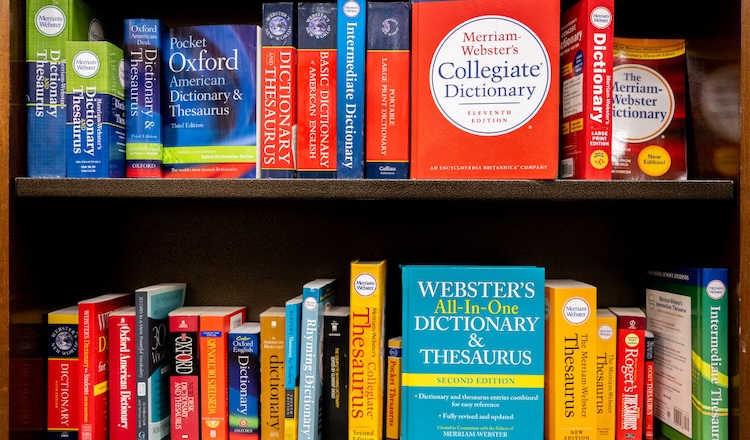
On my bookshelves, I discover that I own three standard English dictionaries (two Merriam-Websters and an Oxford Concise), four Latin and three French dictionaries, and single-volume German, Spanish, and Italian dictionaries. I also own Eric Partridge’s Dictionary of Slang and Unconventional English along with his Dictionary of Catch Phrases, Brewer’s Dictionary of Phrase and Fable, The Oxford Dictionary of Quotations, A Basic Dictionary of Saints, The New Bible Dictionary, The Norton/Grove Dictionary of Music, and The Chambers Biographical Dictionary. I once aspired to own The Oxford English Dictionary, which recounts the history along with the meaning of words; it was originally published in 1928 in 10 volumes, then, later republished in 1989 in 20, weighing in at 137.72 pounds and selling for $999 on Amazon.
I note these books, crowded together with a few other reference books on two shelves in my home library, and they seem lonely. And so they would be if books had feelings, for I have not consulted them in months, some in years. I now rarely go to dictionaries for my definitions but seek them almost exclusively online, either on the dictionary app (supplied by the New Oxford American Dictionary) on my computer or via Google. I use these not because I think them superior but because they are more convenient than walking off to the reference book section of my library, which is in another room in my apartment. In taking this shortcut, I suspect I’m like literally billions of others in this country and abroad.
_____________
Not a good time, ours, to be a lexicographer. But, then, there may never have been a good time. Perhaps the most famous lexicographer of all, Samuel Johnson, described the job as fit for “a harmless drudge,” and “dull work.” Johnson also famously described a patron, which he required while working on his dictionary, as “one who looks with unconcern upon a man struggling for life in the water, and, when he has reached ground encumbers him with help.” Johnson’s own failed patron was Lord Chesterfield, the man who wrote the letters on proper etiquette, education, and the way to social success for his illegitimate son.
Dull work much of lexicography may well be, but it also happens to be significant work—perhaps as significant as any the world of culture has to offer. For a dictionary sets the limits on the meaning of words, and that limit can be, and often is, decisive. Without a proper definition, we cannot know whether bimonthly means every two months or twice a month, whether there is any real difference between “disinterested” and “uninterested,” whether we need discriminate between “deprecate” and “depreciate,” and a great deal more in the way of meaning, nuance, and subtlety in speech and writing.
A lexicographer’s work begins with deciding which of the world’s words deserve inclusion in the dictionary. If the dictionary carries the word “unabridged” in its title, then a decision must be made about the nature of the word: Is the word standard or colloquial, slang or slur, or even unacceptable English? The division here is between those lexicographers who think themselves descriptive and those who think themselves prescriptive. The former include all language that is in use, the latter discriminate more strictly between standard and substandard words. For the descriptive lexicographer, if enough people ignore the distinction between “disinterested” and “uninterested,” “deprecate” and “depreciate,” so then do they. In a democratic spirit, they go along with the majority. A prescriptivist would say they are confusing if not ignoring the difference between the democratic and the demotic. The descriptivist finds much in the world that is amazing, incredible, iconic; the prescriptivist would rather say kaddish over his still-living mother than use such currently vastly overworked words. The argument against the descriptivists is that they abandon the subtle distinctions among words; that against the prescriptivists is that they are verbal snobs.
Some dictionaries are dominated by the descriptivist spirit, some by the prescriptivist. Merriam-Webster’s Second International Dictionary, published in 1934, is prescriptivist in spirit, while the same company’s Third, published in 1961, is descriptivist. Reviewing the latter in the New Yorker in an essay he titled “The String Untuned,” Dwight Macdonald rightly noted that the question was “whether a dictionary should be an authority as against a reporter” on the nature of language. Macdonald preferred to think of the dictionary as a rule book, setting down the proper rules of language. He ended his essay by accusing the descriptivist editors of the Third of having “untuned the string, made a sop of the old structure of English, and encouraged the language to eat itself up.”
Kory Stamper’s Word by Word, published in 2017, is an account of how dictionaries are made. Ms. Stamper went to work for Merriam-Webster in 1998, and remained there for nearly 20 years, 10 of them as an associate editor. Merriam-Webster, she informs us, requires no qualification for becoming a lexicographer apart from a college degree and English being one’s first language. But she makes plain that without a love of language, one really isn’t fit for, or likely to last long in, the job. She qualified on this count, too.
Ms. Stamper doesn’t hold with the distinction between prescriptivist and descriptive, at least when it comes to the making of dictionaries. “We don’t just enter the good stuff,” she notes. “We enter the bad and ugly stuff, too. We are just observers, and the goal is to describe, as accurately as possible, as much of the language as we can.” She views Standard English as another dialect, one of many, and writes:
We think of English as a fortress to be defended, but a better analogy is to think of English as a child. We love and nurture it into being, and once it gains gross motor skills, it starts going exactly where we don’t want it to go; it heads straight for the goddamned electrical sockets. We dress it in fancy clothes and tell it to behave, and it comes home with its underwear on its head and wearing someone else’s socks. As English grows, it lives its own life, and this is right and healthy… . But we can never really be the boss of it. And that’s why it flourishes.
At the heart of Word by Word is the elaborate description of how words of all sorts get into the dictionary. Stamper reminds us that, lexicographically, it is the short words that are the most difficult to define. “Schadenfreude” is easy; “anti-disestablishmentarianism,” no problem; but “as,” ‘like,” and “but” are hard. The word “run” is said to have more than 400 meanings. Words fit for inclusion in a dictionary must also be divested of their politics. In a biographical dictionary, or biographical entry in a regular dictionary, a straight definition of Senator Joseph McCarthy is not easily composed. Nor will that of Donald J. Trump.
Sometimes, as I have noted, an old word takes on a new meaning, and the old meaning is all but lost forever. The word “gay,” which now stands for male homosexual, can never again be used to mean merry, festive, charming. As for “bitch,” the n-word, the c-word, “Yid,” “queer,” “redskin,” and other slurs, they present problems of their own for the lexicographer. Some among them are no longer slurs. The n-word with an “a” on its end is now often used by contemporary African Americans, and it sometimes turns up in rap music without the a. “Queer” has now become all but conventional, with literature by and about homosexuality now taught in universities under the rubric Queer Theory. “Yid” is often used among fellow old Jews, at least it is by this old Jew—though “kike,” best defined by the banker Otto Kahn as “what you call the Jewish gentleman who has just left the room,” remains an immitigable slur. The c-word is currently and is likely to be forever out of bounds.
Kory Stamper devotes an entire chapter to the word “bitch,” which of course started out in life as “a female dog.” Soon enough it became:
2a: a lewd or immoral woman: trollop, slut–a generalized term of abuse b: a malicious, spiteful, and domineering woman; virago–usu. used disparagingly. 3. archaic: man–sometimes used disparagingly. Then there is bitch the verb, meaning complain. The language just won’t stand still.
Perhaps the most extraordinary word in the language is the infamous f-word. For one thing, the etymology is, I believe, unknown, though it first showed up in a 1598 Italian-English dictionary as a synonym for the Italian word fottere. The word can be made to fit anywhere in a sentence: F- if I know. What the f- is the difference? Who gives a f-. F- off, F- up, F- all—on second thought, f- it. Something about its very sound—the soft beginning, the hard ending—gives pleasure in saying it, so much so that even its more publicly permissible euphemisms (friggin’, flamin’, frickin,’ forkin’) are often called into service. Such has been the word’s continuing infamy that it only made its way into the Merriam-Webster’s eighth Collegiate edition in 1973.
_____________
In the just-published Unabridged Stefan Fatsis brings the story of the dictionary up to date. The story is a less than happy one. Author of a bestselling book about the world of Scrabble, Fatsis was able to embed himself into the Online Webster’s Lexicon, or OWL as it is known intramurally at Merriam-Webster’s, and there do the everyday work of the lexicographer. His job was to find new words, prove their worthiness for inclusion in the OWL, and write their definitions. “My Merriam colleagues cranked out definitions as they were getting paid by the entry,” he writes. “For me, completing even one was like flipping over a Volkswagen. Each word looked so simple—I’d written 100,000-word books; how hard could a three-line definition be?—but [these definitions] turned out to be impossibly complicated. Sometimes the challenge was crafting the definition itself. Sometimes it was compiling and crafting the evidence.”
Fatsis introduces many new words, at least new to me. Among them are “sportswashing,” “rickroll,” “derp,” “velo,” “testiflying,” “failson,” and “rawdogging.” Some are more useful than others. One I intend to use is “kakistocracy,” meaning government by the worst people. He reminds us that one of the most looked-up words on Google is “paradigm,” which I can never read or hear without thinking, “Brother, can you spare a dime,” just as when I hear the word “eschew,” I want to say Geshundheit.
“The dictionary’s job,” Fatsis writes, “is to be an unbiased arbiter of language and its evolution, one of the last apolitical authorities standing.” For the lexicographer, the job is, as Fatsis notes, “Sisyphean,” the rock here pushed back by relentless language change, forever rolling down the hill. Perhaps never more so than currently, with the dominance of the internet and digital culture, where words grow faster than dandruff. We owe to the internet such now common words as “podcast,” “social media,” “meme,” and “google” as a verb. We also owe to it the loss of the print dictionary as a useful tool in the negotiation of language.
A word that found its origin on the internet that I’d not seen before but discovered in the November 2025 issue of Harper’s is “gooner.” A gooner is someone who engages in the activity of “gooning.” Gooning, it turns out, to quote from the article, “is a new kind of masturbation. More precisely, a new kind of masturbation at the heart of an internet-based pornography-obsessed Gen Z–dominated subculture every bit as defined and vibrant as the hippies or punks in their prime. The act itself resembles ‘edging’—repeatedly bringing oneself to the point of climax without actually climaxing… . The gooner goons to reach the ‘goonstate’: a supposed zone of total ego death or bliss that some liken to advanced meditation, the attainment of which compels them to masturbate for hours, or even days, at a time.” I’d have as soon not known any of this, but if your work is with words, you want to know them all, even though that is, of course, impossible.
“The internet,” Stefan Fatsis writes, “disrupted every word-driven industry.” Is artificial intelligence likely to increase this disruption? Difficult to say, but what one can say is that AI is in itself in the nature of an anti-dictionary, since it stands for approximate intelligence, whereas the dictionary stands for intelligence at its most precise.
Because of the dominance of the digital culture, with social media bringing new words flying about every which way, the need for useful dictionaries is perhaps greater than we have ever known. Kory Stamper holds that “we are in a cultural moment when words and their meanings matter more to people than ever.” Fatsis adds: “Noah Webster invented the American dictionary. George and Charles Merriman reinvented it as a consumer product. And their 21st-century heirs needed to reinvent it for the digital future. The flow of words won’t stop. The need for a dictionary, human or robot, to steer it shouldn’t stop either.”
But has it stopped? Have we run low on, if not altogether out of, lexicographers? And what might the consequences be if we have? Can a culture persist without its language being properly sorted and set out in definitions at once precise and concise? In their day, there have been The Random House Dictionary of the American Language, The American Heritage Dictionary of the American Language, Funk & Wagnalls’ College Standard Dictionary of the English Language, and others. Today, a new large dictionary seems commercially unfeasible. “No one had imagined,” as Fatsis notes, “that people would stop buying print dictionaries.” But we are at the time when they have.
Each of us, then, is left alone to deal with the English language as best he or she can. I have myself come to believe that grammatically correct English set out in an interesting and precisely arrayed vocabulary is the surest route to effective and elegant prose. An up-to-the-moment dictionary, teeming with important inclusions and useful distinctions, would make the task more than a mite easier. Unfortunately, for now, it appears that we shall have to do without such a precious volume.
Photo: Brandon Bell/Getty Images
We want to hear your thoughts about this article. Click here to send a letter to the editor.